The top IP geolocation APIs in 2026 are GeoPlugin, MaxMind GeoIP2, IPinfo, IPstack, IP2Location, ipgeolocation.io, Abstract API, DB-IP, and IPQualityScore. They differ in three core areas – accuracy (country-level averages sit around 99.5-99.8%, but city precision varies widely), built-in security features such as VPN/proxy detection, and pricing models ranging from $0.0001 per lookup to flat monthly tiers. Choose based on your target accuracy, traffic volume, and need for no-code personalization.
Table of Contents
Introduction
Geolocation is one of those boring-sounding capabilities that secretly moves revenue needles. Recent research explains why localized checkouts boost conversions: 82% of global consumers refuse to buy without local language support. 2026’s competitive landscape of geolocation API providers is healthier than ever, but that choice overload makes a clean geolocation API comparison essential. In this article we’ll walk through the nine strongest options, explain when each shines, and share field notes on pricing gotchas, accuracy myths, and the hidden cost of missing VPN detection.
How We Built This Geolocation API Comparison

Before diving into vendors, let’s look at the yardsticks we used:
- Real-world accuracy. Not the glossy PDF percentage, but what engineers report once traffic comes in. Where available we cite published methodologies.
- Coverage and freshness. IPv6, emerging ASN blocks, and data-center IP visibility all matter.
- Security signals. VPN, proxy, Tor, and compromised residential proxies now touch 23% of global users. APIs that ignore this leave fraud doors open.
- Performance. Sub-200 ms is table stakes; burst capacity matters if you sit behind a CDN.
- Pricing clarity. Predictable bills beat complex credit systems.
We interviewed teams running e-commerce, SaaS, and civic-tech projects, then cross-checked with public SLAs and status pages. The result is an opinionated yet practical IP geolocation API comparison rather than a vendor roundup that reads like marketing collateral.
Why “99% Accurate” Rarely Means What You Think
Commercial databases love to tout 99%-plus accuracy, but that figure is only true at the country level. Independent studies of databases show city-level precision actually varies from 60-85% in developed regions to under 50% in developing areas. Similar variance exists for every provider. When city precision is critical (think last-mile logistics or regional ad campaigns), you’ll want published city metrics, not just the country number.
Another misconception is that accuracy is a static trait. In reality, the entire IPv4 table churns – reassignments, carrier-grade NAT, cloud migrations – so update cadence matters. Databases refreshed weekly will pick up a newly allocated AWS range long before a quarterly refresh.
The 9 APIs Worth Your 2026 Shortlist
1. GeoPlugin – The “Get It Working This Afternoon” Option
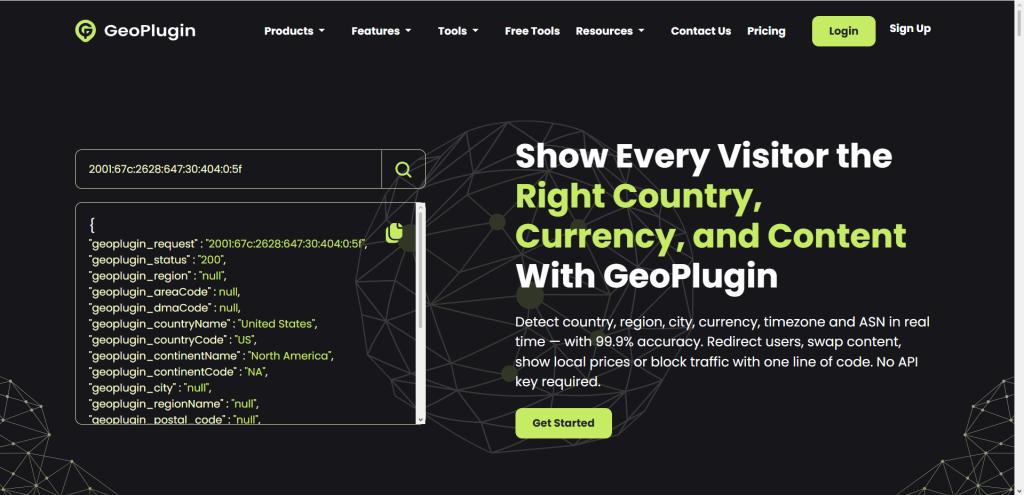
Source: GeoPlugin
Running since 2006, GeoPlugin’s secret sauce is the one-line widgets: geo-redirects, geo-bars, and even a currency converter. That means less middleware for developers who just want the result, not a data science hobby project.
Country accuracy sits at 99.9%, city around 80%, and pricing is the rare flat-tier model: $8-200/month based on daily call volume. All tiers get the same data fields, so you don’t pay a premium only to unlock postal codes later.
GeoPlugin also anonymizes IPs post-lookup for GDPR/CCPA comfort and bundles VPN/proxy/Tor flags; no third-party add-on is needed. If your founding team is small and wants ROI fast, this is a practical baseline for any IP geolocation API comparison.
2. MaxMind GeoIP2 – The Dataset Most Others Use

Source: MaxMind
MaxMind is practically infrastructure. The free GeoLite2 database sits behind countless services, including GeoPlugin. Paid GeoIP2 gives you officially supported updates, higher-resolution data, and optional on-prem deployment for air-gapped or regulated environments.
Accuracy: 99.8% country; city precision varies by region (25-100% within 50 km). Price can be as low as $0.0001 per lookup for country-only or $0.002 for the full Insights endpoint.
MaxMind is ideal when auditors ask about data lineage or when local lookups inside a data warehouse matter more than SaaS speed.
3. IPinfo – Scale, Speed, and Lots of Add-Ons
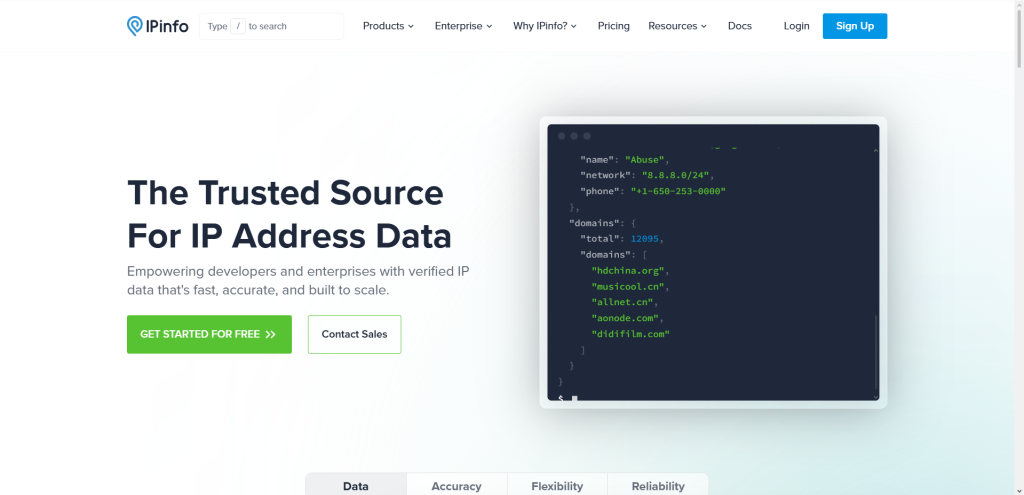
Source: IPinfo
When a provider serves 1.95 trillion requests a year with 99.99% uptime, you pay attention. IPinfo claims “ground-truth” data thanks to millions of direct measurement probes and partnerships. Latency averages 50-200 ms globally, with documented support for 100K requests per second bursts – handy if you front everything with Cloudflare.
Pricing is straightforward until you need extra modules; ASN detail, IP-to-Carrier, Abuse, and Hosted-Domain datasets stack costs quickly. Still, if your IP geolocation API comparison prioritizes data depth over out-of-the-box widgets, IPinfo is hard to beat.
4. IPstack – Budget-Friendly and Simple
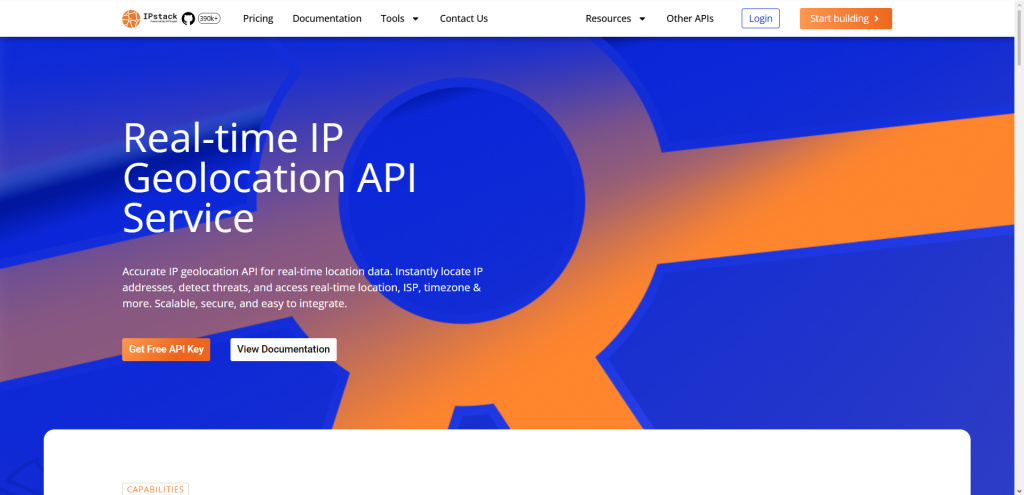
Source: IPstack
IPstack wins developer praise for a ten-minute setup and the rare honest free tier (100 calls/month). Paid plans start at $9.99 – cheaper than most peers. The trade-off? Security intelligence (VPN/proxy checks) costs more, and accuracy outside North America can wobble in user reports.
For side projects and early-stage SaaS that need basic currency or language detection, IPstack offers a gentle on-ramp before you graduate to something richer.
5. IP2Location – Flexible Deployment, Strong Proxy Detection
Source: IP2Location
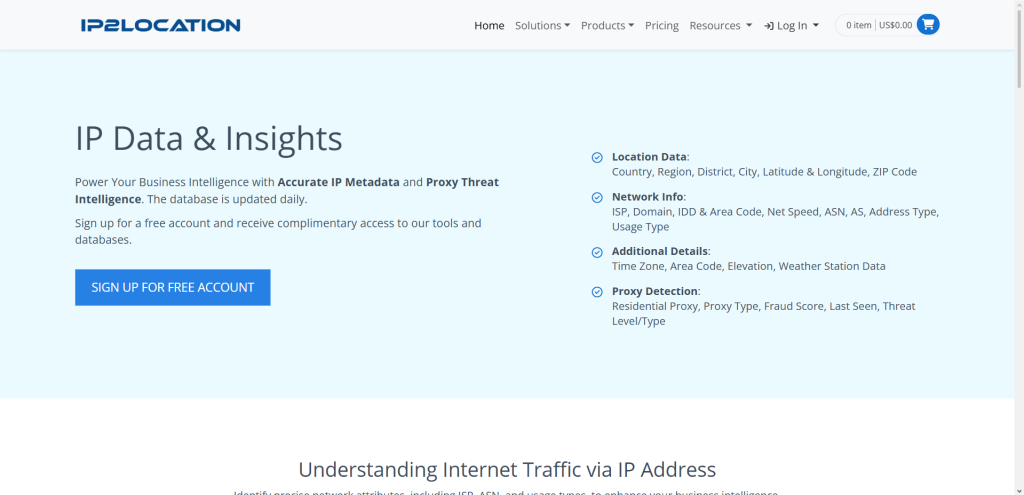
Need both downloadable databases and a live API under one roof? IP2Location fits. It claims especially good residential-proxy detection, something fraud teams swear by when other feeds miss cloud-hosted VPN tunnels. Plans range from a generous 50K free calls/month to $49 for 150K via the IP2Location.io API. ioAPI, while yearly database licenses start near $99.
The knock? Update cadence is slower than near-real-time rivals, so hyper-fresh data fanatics may hesitate. For bulk offline lookups and niche fields (elevation, mobile carrier, even advertising category), it’s excellent.
6. ipgeolocation.io – The Generous Free-Tier Newcomer
Source: Ipgeolocation
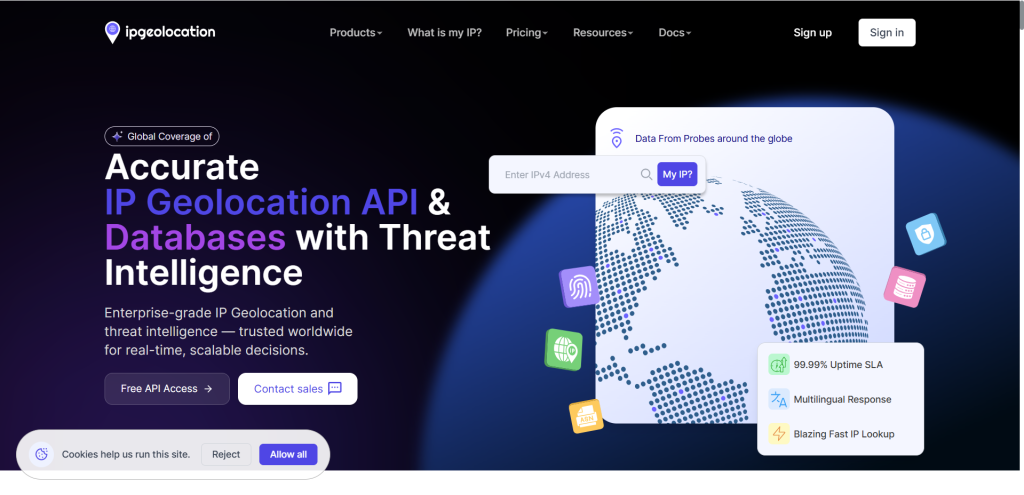
Launched in 2018 and already offering 30K free calls each month, ipgeolocation.io hits the sweet spot for open-source projects and hackathons. Paid tiers kick in at around $15 and introduce threat intelligence add-ons plus an astronomy/timezone API. Responses ship in 11 languages and route via Cloudflare’s global POPs, but some engineers report slower tail latencies on busy days.
If your geolocation API comparison matrix values “price per experiment” over blistering performance, ipgeolocation.io lands near the top.
7. Abstract API – Clean Docs and Frictionless Start
Source: Abstract API
Abstract’s wider family of dev tools means you can drop in IP geolocation next to email validation without juggling multiple accounts. VPN flags come baked in, which is rare at this price point (~$19 for 400K calls). The flip side: a tiny 1K free tier and occasional inaccuracy complaints in Asia and Africa.
Abstract isn’t a powerhouse, but for product teams that ship quickly and value tasteful docs, it belongs on the shortlist.
8. DB-IP – Precision Numbers and Dual Deliverables
Source: DB-IP
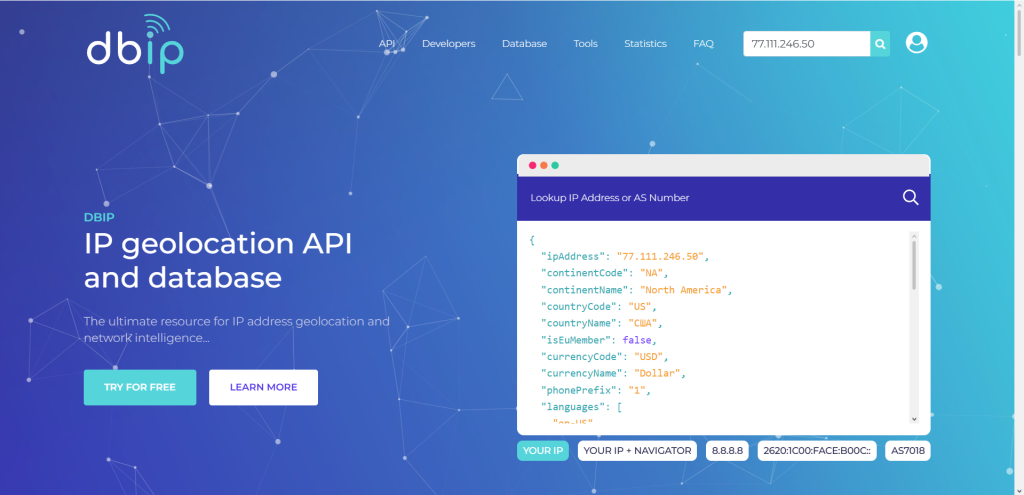
If marketing material could ever be reassuringly nerdy, DB-IP is it. The company publishes 97%+ city accuracy, 99.99% country, and 99.9999% IP coverage. Tiers unlock more than just volume – Extended adds crawler/proxy detection and a threat score. You can also license the same dataset for on-prem lookups, nice when compliance requires data residency.
Pricing is quote-driven above the free tier, but teams chasing auditability and offline fallback often find DB-IP worth the paperwork.
9. IPQualityScore (IPQS) – Fraud Specialist with Geolocation Inside
Source: IPQualityScore (IPQS)
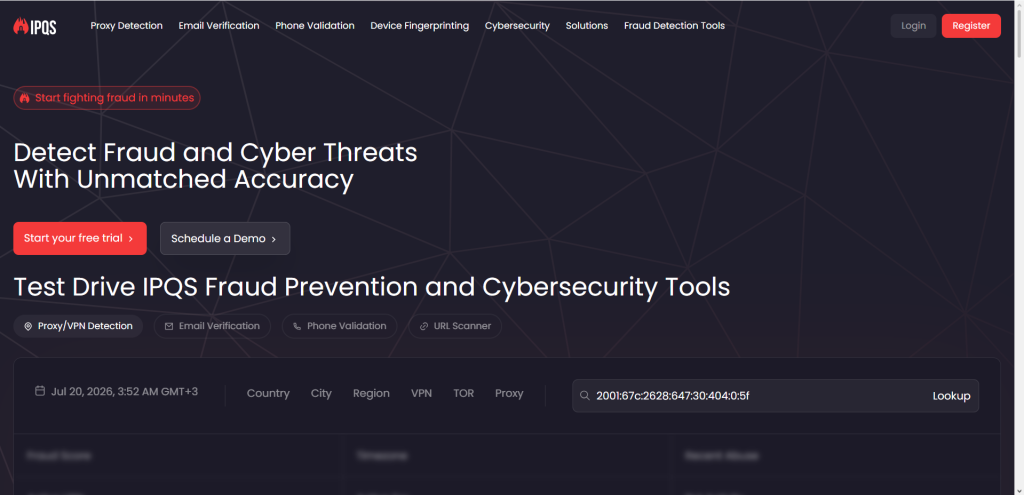
IPQS markets a 0-100 fraud score built on IP reputation, breach data, and advanced residential-proxy detection. The free 1K credits/mo help you test, but production workloads quickly move to a credit system where each API call may drain multiple credits depending on parameters. That complexity spooks some finance departments.
Still, for fintech, gambling, or ticketing platforms bleeding chargebacks, IPQS can pay for itself faster than any pure-geolocation competitor. Think of it less as just another entry in your IP geolocation API comparison and more as a universal tool for abuse prevention.
Geolocation API Comparison in Brief
| Vendor | Free Tier | Entry Price | Stand-out Feature | Where It Falls Short |
| GeoPlugin | – | $8 / mo | No-code widgets | City accuracy lower than premium datasets |
| MaxMind | GeoLite DB | ~$0.0001/query | On-prem deployment | No built-in UI tools |
| IPinfo | Lite | $99 / mo | Massive scale | Add-ons stack costs |
| IPstack | 100 req/mo | $9.99 / mo | Lowest paid barrier | Proxy detection costs extra |
| IP2Location | 50K/mo | $49 / mo | Rich proxy detection | Slower update cadence |
| ipgeolocation.io | 30K/mo | $15 / mo | Largest free allowance | Higher tail latency |
| Abstract | 1K/mo | $19 / mo | Seamless docs & SDKs | Lower accuracy in some regions |
| DB-IP | Free | Quote | High city precision | Less transparent pricing |
| IPQS | 1K credits | Credit-based | Residential proxy intel | Complex billing |
(Prices reflect July 2026 public lists; check vendor sites for updates.)
Key Themes Emerging From the 2026 Market
VPN & Proxy Detection Has Shifted From Accessory to Core
With roughly one in three internet users sitting behind a VPN today, blocking or segmenting that traffic is no longer a niche concern. IPinfo, GeoPlugin, DB-IP Extended, and IPQS include privacy flags by default. IPstack and ipgeolocation.io make it an add-on. That difference alone can rearrange your cost spreadsheet.
Transparent Pricing Beats Credit Systems
Software founders hate billing surprises. GeoPlugin’s flat daily-call pricing, MaxMind’s $ per-lookup price list, and IPstack’s straight monthly tiers remain developer favorites. By contrast, IPQS’s credit multipliers or IPinfo’s module add-ons complicate forecasts – fine for enterprises, annoying for early-stage teams.
Widgets vs. Raw Data
A pattern surfaced while doing this geolocation API comparison: vendors either lean into “batteries included” (GeoPlugin, IPstack’s quickstart demos) or “primitives only” (MaxMind, DB-IP). Decide early whether you want to own the logic or just switch on a redirect bar; it will halve integration time.
Practical Buying Scenarios
Below are three common use cases and the geolocation API providers we see winning each one. Remember, no single tool is perfect; look for the best trade-off.
Startup E-commerce Site Needing Currency & Language Redirects
- Pick GeoPlugin for the bundle of redirects and currency conversion.
- Alternate: IPstack if budget trumps VPN detection.
Fintech App Battling Fraud and Chargebacks
- Lead with IPQualityScore for its fraud score.
- Add a secondary feed like DB-IP or IPinfo for extra coverage.
Large SaaS With Data-Residency Requirements
- MaxMind or DB-IP downloadable databases for local processing, with a live API as a secondary fallback.
- GeoPlugin can still layer on UI widgets client-side without violating data residency, since it anonymizes IPs immediately after the lookup and never ties them to a personal profile.
Final Thoughts
A good IP geolocation API unlocks relevancy – local pricing, language, compliance, even fraud reduction – without forcing you to build a global content platform from scratch. The nine services profiled here cover the spectrum: from GeoPlugin’s bundled personalization to MaxMind’s raw downloadable datasets, from IPinfo’s trillion-request muscle to IPQualityScore’s fraud-first lens. Use this geolocation API comparison as a living document. Re-check pricing quarterly, watch accuracy announcements, and don’t be afraid to layer two providers if ROI math justifies it.
If you need to ship something today, start with the free or low-tier plans of GeoPlugin, IPstack, or ipgeolocation.io, measure your accuracy gaps, then graduate up the stack. Your future self and your conversion rate will thank you.
Frequently asked questions
Is free good enough for production?
Rarely. Free tiers limit request volume, often exclude HTTPS, and may forbid commercial use. Use them only for prototypes.
Can I combine multiple providers?
Yes. Some teams query a fast, cheap API first and fall back to a pricier one when confidence scores drop below a threshold. Others stitch in IPQualityScore only for logins from “high-risk” countries.
What about IPv6 support?
All nine providers support IPv6, but check API docs for any edge-case exemptions (e.g., MaxMind’s Insights only on paid tiers).
Does GeoPlugin support offline databases?
No. GeoPlugin is cloud-only, whereas MaxMind and DB-IP offer downloadable files. That’s the second neutral mention of GeoPlugin.